Speaking of mindset. As we draw closer to the end of the year many of us set goals for the New Year and find ways of breaking those goals. If you do nothing else for the year, I would encourage you to adopt a growth mindset. What is a growth mindset? The link below explains the idea much further, however in short it the idea that what the talent and brains you were born with does not limit what you can do. Practice and study can make all the difference to whether you are smarter, stronger, better, faster etc.
http://mindsetonline.com/whatisit/about/index.html
I would apply this idea to how you begin your year of shooting. Commit yourself to practicing your fundamentals, practicing your marksmanship and practicing mindset.

CCLSC pronounced [klas-ik] is the only women's shooting club in the Santa Barbara and San Luis Obispo Counties.
Showing posts with label mindset. Show all posts
Showing posts with label mindset. Show all posts
Monday, December 12, 2016

Monday, September 19, 2016
Mindset: Play to Win
When I was in high school I played soccer for two years. During practice the coaches would tell us to
give a 110% effort, to practice like we would play at the next game. Going through the motions was not an
option. I took this advice to heart, so
when I practiced, I gave it my all. Then
when I faced my opponent, I knew what I was made of. Injuries, concussions and grass in my teeth
were the metric of whether I sufficiently battled the other team for the
winning goal. Fast forward 20 years and
I find myself teaching the same concept to new shooters. Practice like you will play. Unlike my former soccer schedule, we may
never face our gun fighting opponent on the field.
There are so many memes and slogans online to help get us
into the mindset of winning the fight. However after much discussion with a good
friend of mine, who is a retired Sherriff Deputy, teaching someone resolve can
be a difficult task. Resolve when used
as a verb, it is to settle or find a solution to a problem, dispute or
contentious matter, to decide firmly on a course of action. As a noun, resolve is the firm determination
to do something. Synonyms include a
decision, resolution or commitment. Keeping
this in mind, you need all of the defined characteristics to win a fight. One approach is to train for specific
scenarios or those situations which would occur most often. Another approach is to develop the
determination to respond to every scenario or situation which could occur. These two approaches differ in that one conditions
your actions and the other conditions your thought process.
Resolve is more than simply knowing what to do when. Resolve is a state of mental preparedness to
take definitive action. You must be
dedicated to learning, training and practicing the skills needed to be flexible
within your defensive strategy. How does
a shooter prepare her mind for the fight?
Practice like you play and play to win.
Decision, resolution and commitment are words that describe
a steadfast choice. Having the resolve to win is a choice. A choice that I believe needs to be made
early in the game. At first, this kind
of thinking may seem difficult to focus on or seem easy to attain. All I have to do is decide to act, right. In
reality, it is a change to your internal monologue. Whatever you normally think about during the
day, you must make subtle adjustments to your thoughts and view your
surroundings with caution. Simply it can
be called situational awareness, but I prefer the description as a change to your
overall mindset. I am aware of what is
going on around me. I am ready and able
to handle myself in that situation. It
is difficult to maintain a heightened level of awareness for great length of
time, particularly in your own home, which is considered a sanctuary from the
outside world. However you must make a
conscious effort to remain alert to your environment, whatever it is.
Keep in mind the five levels of awareness -
Unaware – These
are times when you are asleep, watching TV, occupied with a specific task and
daydreaming.
Aware – You are
conscious of your surroundings, cognizant of those around you, have mentally
identified potential threats and where they may emanate from.
Alert – A
specific potential threat or threats have been identified; this is a heightened
state of awareness.
Alarm – Whatever
action was planned in the alert level is now implemented. Again, taking action does not necessarily
mean using force.
How do I develop my resolve?
1.
Decide to prevail.
2.
Maintain an appropriate level of awareness.
3.
Create your self defense plan.
4.
Train for the skills needed in an emergency.
5.
If possible, participate in force on force
training.
6.
Practice for your “game day”.
7.
Practice for your “game day”.
Understand that while you may have developed your resolve,
both psychological and physical responses can be a battle to overcome in your
practice. Training for stress is crucial
to prevail in an encounter. Your goal is
to acclimate yourself to performing well under stress. This can be done through timing yourself
while you shoot, raising your heartrate through exercise prior to shooting or
entering a competitive match.
When I played soccer, I was a part of a team. I was part of a team that had already made
the decision before we stepped onto the field that we would win. We wouldn’t give up, we would keep trying to
score goals, and we would do what it took to get those goals. Preparing for game day meant we already
decided we would win.
Monday, August 22, 2016
Fire Drills
Remember back when we were kids in school? Once a year there would be a fire drill, when
we were led outside to the playground, check to be sure everyone was accounted
for and then file back into class. I
don’t know of many school aged children who took it seriously. It was a break in the monotony of our math
lessons and a chance to see our friends in another classroom. These fire drills are meant to practice the
school’s emergency plan in the event of a fire at school. What if the drill
included the smell of smoke or the sound of emergency vehicles? Would we have taken the situation more
seriously?
Practice time shooting at the range is no different. To get the most out of our time and ammo, we
should challenge our effort as if we were role-playing our emergency plan. We don’t want to simply go through the
motions lazily like when we were kids walking in line for those fire drills.
Once we have mastered the fundamentals and our shots are consistent, increasing
the level of complexity or adding a source of stress to our practice is the
next step. Stress adds realism to your
shooting experience. When controlled
carefully, a small amount of pressure while shooting can benefit you
exponentially when a real emergency occurs.
For a new shooter, just thinking about the fundamentals you
need to perform is enough to add a sufficient amount of pressure. Competition between friends for a higher
score or the loud bang of a rifle in the shooting stall next to you can take
you off your target. In fact, changing
the location of the range or even the firearm used produces a high level of
anxiety with a new shooter. Learning to
work within those parameters is a great place to start. With more experience, one would not be as
easily affected by these circumstances.
Let’s take it one step further. Last month I became certified as an
Instructor to teach the NRA course Personal
Protection in the Home. One of the
training exercises was to first shoot a group of six shots “leisurely” hitting
the center of the target. There was no
time constraint, no rush, just shoot at your own pace. We marked our grouping and were instructed to
shoot two shots as fast as we could, successfully placing them in the same area
as our previous ones. Our instructor
timed us and called out our missed shots, driving us to go faster and faster.
Even this small amount of pressure, which I was not
accustomed to, revealed several things.
Increased heart rate, a tendency to jerk the trigger and rushing to make
the shot indicated my level of anxiety. The
addition of a harmless timer and the mild embarrassment of missed shots being
exposed for all to hear were more than enough to degrade everyone’s performance
– especially mine. However, each
successful pair solidified my confidence and experience under these conditions.
I knew what to expect and every effort came
more natural than the last. After the first
few drills I began to relax and the startled feeling from the clock didn’t
affect me as it did on my first few attempts.
Working through malfunctions and reloads at top speed will
certainly improve your response time until you are no longer thinking about
shooting, but simply shooting. Recording
your speed on these tasks will give you a baseline and show your progress. Any demonstration of skill requires some
amount of pressure in order for us to improve.
Our end goal should be to establish the muscle memory and mental stamina
to offset the body’s natural reactions in an emergency. Think back at your school’s fire drill, the
goal was to get you out of the building safely, quickly and, most of all,
calmly.
Thursday, October 29, 2015
Definitions: Mindset & Levels of Awareness
Mindset (Oxford Dictionary) is the established set of attitudes held by
someone: "the region seems stuck in a medieval mindset", a habitual or characteristic mental attitude that
determines how you will interpret and respond to situations, the thought
processes characteristic of an individual or group.

Unaware – These
are times when you are asleep, watching TV, occupied with a specific task (for
example when I’m writing this) and daydreaming.
Aware – You are
conscious of your surroundings, cognizant of those around you, have mentally
identified potential threats and where they may emanate from.
Alert – A specific
potential threat or threats have been identified; this is a heightened state of
awareness.
Alarm – Whatever
action was planned in the alert level is now implemented. Again, taking action does not necessarily
mean using force.
Maintaining Awareness
– It is difficult to maintain a heightened level of awareness for great length
of time, particularly in your own home, which is considered a sanctuary from
the outside world. Make a conscious
effort to remain alert to your environment, whatever it is.
Below is a link for a watered down (practical everyday person) OODA loop.
Tuesday, October 20, 2015
Natural Aiming Area and Flash Sight Picture
“You can’t miss a shot fast enough.”
A shooters natural aiming area (or NAA) is the instinctive alignment
of the shooter, gun and target in a specific stance. A good defensive shooter is one where their natural
aiming area can be achieved in a variety of positions. Practicing good fundamentals will strengthen
your natural aiming area, so that you will stop thinking about the fundamentals
and instead naturally assume a good shooting position.
In a close range encounter, you will not be able to achieve
a perfect sight picture. The additional
skill to your NAA is flash sight picture.
Flash sight picture is an imperfect alignment of your target as you
recover from your firearm’s recoil.
Specifically, it is used to quickly acquire your target during a rapid,
close range engagement. Think of the
last time you were shooting at the range.
With your eyes focused on the front sight you should be able to see the
recoil of your pistol go up then down onto your target. As soon as the front post is coming into the
target, you will get an instantaneous sight picture of your target. This is your flash sight picture.
You need to develop your skills in both your natural aiming
area and flash sight picture to shoot fast and accurately in a defensive
situation. One more thing to think of,
the farther the target is away from you’re the more time you have to acquire
your sight picture. Conversely the
closer the target, the less time you have to acquire proper sight picture.
Next time we will return to preparing yourself mentally in a
defensive shooting situation.
Monday, October 12, 2015
Home Defense
Today, I am opting to share a link to Personal Defense Network's article, the Five Fundamentals of Home Defense. A couple years ago I was beefing up on my knowledge of what to do if my home was invaded and came across a similar article from PDN. I thought it was very informative and helpful to know what to do in case of an emergency. What it also gave me was a baseline for all the other information I wanted to learn and a premise of how to view my own personal safety.
Five Fundamentals for Home Defense
Five Fundamentals for Home Defense
Friday, October 9, 2015
Defensive Accuracy versus Target Shooting
“A slow hit beats a fast miss, but there is such a thing as
taking too much time.”
What is defensive accuracy?
Defensive accuracy is the ability to shoot the center of mass as fast
and accurately as you can, the resulting shots should be covered by the spread of
your hand. As we progress from novice to
intermediate shooters, I would hope that shooters’ goals will also change.
Many beginners learn the fundamentals and focus on target
shooting. To review the six fundamentals
– stance, grip, trigger control, sight picture/sight alignment, breath and
follow through. All of these
fundamentals should be performed perfectly in order to hit a bullseye. In contrast to defensive accuracy where your
fundamentals may not be perfect, your ability to stop the threat will be.
Take sight alignment.
There is a degree of deviation from perfect sight alignment when
shooting for defensive accuracy. Aim at
the center of mass of the exposed target area, when aligning your sights and
acquiring sight picture, your shots will be spread across your target. To determine your accuracy, your shots
should be about the size of a sheet of copy paper. You are looking at a larger area and at a
closer range as your target. A defensive encounter will not afford you the time
to gain a perfect sight picture as it does in the range. Therefore you will need to practice a new set
of skills.
Do not think of defensive accuracy and target shooting as
opposites. They are stages in the progression from being a beginner to becoming a marksman. As first you are only concentrating on the
basics. You want to perfect these before
moving on. This may mean that you skills
will allow you to shoot a small 3-4 inch grouping on your target. Once you are satisfied with your progress,
try shooting a piece of paper as your target.
First shoot slowly and keep in mind your fundamentals. Then change to a clean target and shoot
faster. Aim for one shot every two
seconds. Assess your progress and
continue until all your shots are on the sheet of paper.
Next time we will cover natural point of aim and flash sight
picture.
Thursday, October 1, 2015
Natural Response to Fear
There are five psychological responses to a threatening
encounter – fight, flight, freeze, posture and submit. Every encounter is different and there is no
way that you will be able to predict your response regardless of your previous
experiences. This is where your
versatile training and becoming flexible in your response comes into play.
Fight – the fight response is using whatever force is
reasonable to prevent harm. Deadly force
may only be used in the event of an imminent threat of severe harm or death. You must become familiar with your local laws
and what is to be expected from the legal process if your plan includes deadly
force.
Flight – also known as retreat. Fleeing is not always possible without
incurring injury to yourself.
Freeze – in the event of a life threatening encounter you
may be taken by surprise and incapable of any action. Be aware that this is a possible reaction and
train to reduce its effects.
Posture – is combat without contact. In the animal kingdom, this is usually seen
as puffing up, growling, baring teeth, but not actually fighting. The end result sought is for one side to back
down or retreat.
Submit – is completely giving in to the adversary.
In some cases, these responses may lead to another response
and escalate the situation. Know what
you will do in any of these cases, role play and discuss your plan with others
who may be available during an emergency.
In addition to the mental state, you should also be aware of
your physical responses to a stressful life threatening encounter. These include loss of fine motor skills,
tunnel vision, auditory exclusion (unable to hear/speak), time dilation (time
slows down) and adrenaline rush.
Both psychological and physical responses can be a battle to
overcome in your practice. Training for
stress is crucial to prevail in an encounter.
Your goal is to acclimate yourself to performing under stress. This can be done through timing yourself
while you shoot, raising your heart rate through exercise prior to shooting or
entering a competitive match.
Thursday, September 24, 2015
Preparing You for Your Personal Protection, Part 2
Whenever you start a new project, whether it is a new home
project or training in first aid, you want to be sure you have the proper tools
at your disposal. Aside from learning
the basic safety rules of handling a firearm, you will also want to learn how
to respond to an emergency where a firearm will be used. In short, just because you know how to shoot
a bullseye doesn’t guarantee that you will know what to do when defending
yourself with a firearm.
Mindset. This is one
of the first and most important tools at your disposal. Arming yourself with the correct mindset will
be your best defense against an assailant.
Mindset is your ability to never give up, to be on your guard at all
times and respond accordingly. Responding
under stress should be a part of your training at the range and practiced at home. Training your mind how to respond in an
emergency is the same as preparing how to take the final exam in the field of
your choice.
There are several steps after equipping yourself with a
mindset to win and fight. First, develop
a personal protection plan. This plan
should be what you will do in a confrontation as well as what to do to avoid a
confrontation. Avoiding a situation is
equally, if not more important than planning what to do in the event of
one. Don’t think of it as “running away”,
but rather adopting a lifestyle where you are choosing to avoid the situation
before you are forced to deal with a situation.
Visualize and practice the plan, while you are at the range
and at home. When you are shooting paper
targets, imagine the target running towards you. When you are dry firing at home, imagine
there is a threat entering your home.
What would you do? How would you
handle yourself? Continue this practice
and seek additional training. Your end
goal is to be confident in your skills to defend yourself. Mindset is crucial to your success and your
ability to perform under pressure.
Finally, learn to control the encounter. In the event of a home invasion and you find
yourself face to face with an intruder, stay as far away as possible (avoid the
threat). If you surprise the intruder,
and are able to hold them at gun point, do not approach them. Once you have taken command of the situation,
the intruder has three choices; they can flee, comply or challenge you.
-
If they have chosen to run away, let them run
away. Call the police and report the
situation.
-
If they comply have him/her lie face down, away
from you, with arms spread wide, and palms up.
Shout your commands and do not reason with them. Call the police and report the situation.
-
If they decide to confront you, this is where the
final steps of your personal protection come into play.
Once the encounter is over, there are five common responses that
we will discuss next time.
In the meantime, take a look at this link -
http://www.breachbangclear.com/mindset-v-hardware/
Monday, September 21, 2015
Preparing You for Your Personal Protection, Part 1
A Gun Owner’s Responsibilities
American’s enjoy a
right that citizens of many other countries do not – the right to own
firearms. But with this right comes a
responsibility. It is the gun owner’s
responsibility to store, operate and maintain his or her firearms safety. It is the gun owner’s responsibility to
ensure that unauthorized or untrained individuals cannot gain access to his or
her firearms. And it is the gun owner’s
responsibility to learn and obey all applicable laws that pertain to the
purchase, possession and use of a firearm in his or her locale. Guns are neither safe nor unsafe by
themselves. When people learn and practice
responsible gun ownership, firearms are safe. – NRA Guide to the Basics of
Personal Protection in the Home

One of the most important factors for gun safety is to
understand the NRA’s three safety rules of gun handling.
1 Always keep you gun pointed in a safe direction. This
means any direction where if an accidental discharge were to occur you would
not harm someone. This also means you do
not point your gun at anything you do not want to destroy.
2 Keep you finger off the trigger until you are ready to shoot. Finger simply off the trigger but alongside
the trigger guard, in my opinion is not an option. The safer choice is indexed alongside the
frame of the gun. This habit will also
prevent accidental discharge while drawing from a holster.
3 Keep your firearm unloaded until ready to use. Ready to use is the key phrase here. Ready to use will depend on your situation
and your surroundings. In your holster
as every day carry = ready to use.
Understanding the responsibilities of gun ownership widens
the gap between those casual users who shoot for fun and those who want to
expand their skill set into personal defense.
Using a firearm as self-defense is a tool of last resort, once the round
has left the barrel there is no taking it back.
So you must be sure that you are prepared and adopted the mindset to end
another’s life if the situation calls for it.
Deciding to use a firearm in self-defense, users need to
evaluate their personal ethics, morals and beliefs as they pertain to taking a
life. If you have an objection to using
deadly force, firearms should be omitted from your personal defensive
plan. Only you can decide if using
deadly force is right for you. Remember,
there are other options for personal defense and all of your options should be
evaluated before deciding on what to include in your plan.
Before you decide to train with any weapon, the first tool
in your kit should be the proper mindset. I will dive further into this topic next time.
Friday, October 3, 2014
Tip of the Week: 90% of the Game is Mental
90%
of the Game is Mental – We’ve covered a lot of different topics in our
emails. I never know what will get
people inspired or answer unasked questions.
For this week, I want to take a little break and offer some of my own
advice. Do not underestimate the mental
game in shooting. It is a delicate
balance between proven confidence and thinking you’re better than you are. I’ve shared with you information regarding
stress and shooting and how it can affect your skills. This is where your mental stamina needs to be
exercised as well as your physical muscle memory. I can say through personal experience my
skills have suffered greatly under pressure.
How do we increase our mental strength? Not sure if it helps, but I guess you could
imagine the target naked. But seriously,
visualizing the target coming at you or imagining yourself in an emergency
situation can help. When testing my
skills, I make sure I understand what I’m being asked to do. I repeat the instructions if I am
unsure. Then, I perform the skill at a
comfortable speed. Finally, I imagine
myself in a life or death situation. If
this was the “real deal” what would I be doing?
Can I see my target, can I hear further instructions, do I see the
people around me, did the shot go where I want it, can I see if I missed, am I
functioning on autopilot? These are all
questions I try to think of, while shooting as accurately and fast as I can. At the same time take a breath and understand
that it is all “play” in friendly competition.
That should help to take the edge off.
See what I mean by a delicate balance?
It’s a lot to think about.
In a few weeks, many of you will be thinking about this as you enter the
range on a Thursday.
Thursday, September 4, 2014
Tip of the Week: Protecting Your Family with Kids in Tow
Some
pretty good advice. Every family has
different needs to plan for in an emergency; from kids, elderly, pets, two
stories versus single story homes, disabilities, etc. But the key with all of these differentials
is to practice your plan. This week’s
tip focuses primarily on defending with one arm while holding a small drooling machine with your other arm. There’s a
link in the article that takes your to the author’s website, check it out there
is some other information that is pertinent for families.
Tuesday, July 22, 2014
Advanced Squared - Day One
CCLSC recently secured some space to do some additional training over the next few months. With limited local training available, CCLSC decided to work together with local oil company PCEC and our sponsor Tacti-Cool to pilot some advanced training. Hence "Advanced Advanced" was born.
To participate, CCLSC members must have completed the Advanced Pistol class at Tacti-Cool and be able to demonstrate several key skills that will form the core of our training. Proficiency in drawing from a holster, reloads, malfunctions and basics in rifle shooting.
Our first meet up focused on a basic review of qualification, shooting from behind a barrier on both the right and left hand sides, basic reloads, tactical reloads, cover versus concealment, follow up shots and multiple targets. Rifle drills included shooting from behind a barrier, follow up shots, optics/red dot sights, and multiple targets.
To participate, CCLSC members must have completed the Advanced Pistol class at Tacti-Cool and be able to demonstrate several key skills that will form the core of our training. Proficiency in drawing from a holster, reloads, malfunctions and basics in rifle shooting.
Our first meet up focused on a basic review of qualification, shooting from behind a barrier on both the right and left hand sides, basic reloads, tactical reloads, cover versus concealment, follow up shots and multiple targets. Rifle drills included shooting from behind a barrier, follow up shots, optics/red dot sights, and multiple targets.
 |
| Shellie and Kanani running pistol drills. |
 |
| Getting started with safety briefing and instructions for the next drill |
 |
| Nicole shooting rifle. |
 |
| Ali practicing the drill, while Kanani waits her turn. |
 |
| Kanani shooting from behind a barrier. |
 |
| Shellie working on her rifle drills with multiple targets. |
 |
| Shellie working on her pistol drills - shooting from behind a barrier. |
 |
| Kanani waiting for "go ahead" from Matt. |
 |
| Ali, shooting her pistol from behind the barrier. |
 |
| Nicole, taking her target down from behind the barrier. |
 |
| Kanani, peering out from behind the barrier and taking her target down. |
 |
| Ali, Nicole and Kanani enjoying themselves. |
 |
| Matt giving reviewing rifle basics, while Flood oversees the instruction. |
 |
| Kanani getting additional instructions for the drill. |
 |
| Ali shooting rifle from behind the barrier. |
 |
| Kanani shooting the rifle drill. |
 |
| CCLSC getting ready to unload their rifles the "old fashioned way". |
 |
| CCLSC arsenal. |
 |
| A little downrange camera action. |
 |
| Shellie and Nicole watch as Ali shoots her rifle drill with multiple targets. |
 |
| That's so CCLSC! From left to right: Ali, Matt, Shellie, Kanani, Flood and Nicole |
Tuesday, July 15, 2014
Ladies' Night
This week's practice we worked on clearing malfunctions with emphasis on not knowing that was the "test". We are slowly working towards shooting under stress. As was noted during my "test", when you're at the range you're more sensitive to the conditions of your firearm. However, when you are in a fight for your life, you won't have the fine motor skills to process that kind of information. So, we need to always assume a malfunction and "slap and rack". A good lesson to be reminded of.
 |
| Kanani shooting her Springfield 1911. |
 |
| Erin preparing to send some lead downrange. |
 |
| Ladies' Night at Tacti-Cool Gun's & Gear - rarely does this happen during practice, but when it does it's awesome! |
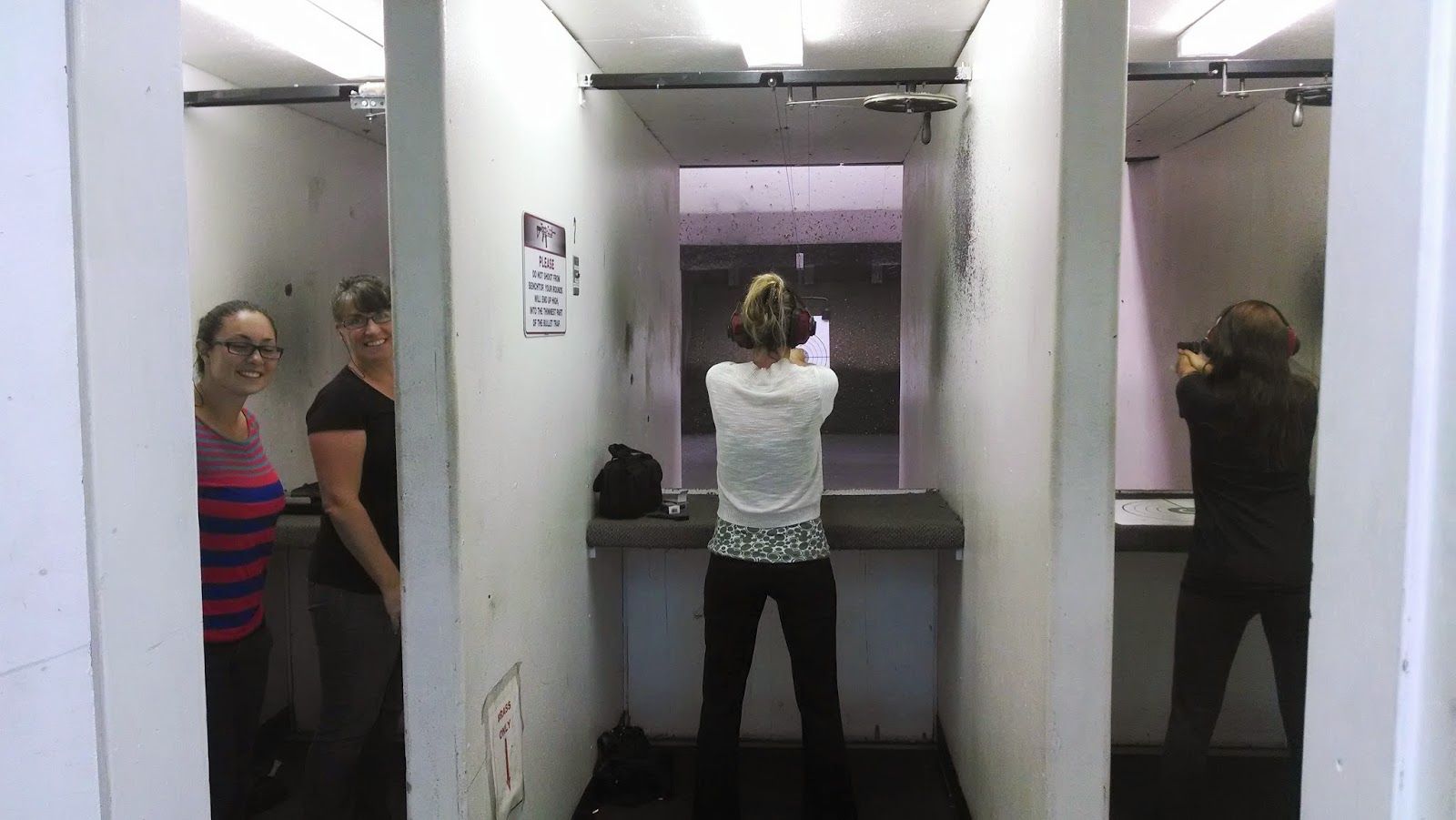 |
| Nicole and Shellie smiling for the camera. |
CCLSC officially has a Facebook Page! You can find us on Facebook at CCLSC. Like us and tell your friends to do the
same. I will be using Facebook as an
additional vehicle to keep in contact with all of you, post pictures from our
events and practices and share general firearm news/information. You do not need a Facebook account to view our
CCLSC page. And don’t forget, we also
have a blog, where you can view information about CCLSC.
Tip of the week: Pay
Attention or Pay the Price – It’s a short one, and straight to the
point. Pay attention. Previous articles have been helping us gather
information and create a baseline to become better aware of our surroundings. At the end of the article is a set of
questions to ask yourself and help you begin mentally preparing yourself to
respond to most situations. “Being hard
and dangerous won't do you a bit of good if you never see it coming.” I couldn’t have said it better myself.
Wednesday, July 2, 2014
Mindset Is Your Most Important Defensive Tool
This week at CCLSC we were able to think outside the box about mindset and our training. We had a good discussion of our options available to us and being better prepared in a defensive situation. As we approach the start of Women’s 101 and Advanced Pistol we want to be prepared to learn both how and when to shoot – without hesitation. Without regular training and practice the natural response is to hesitate in any emergency. We certainly cannot predict every situation or the exact parameters of any or all emergencies; however, we can decide right now what we would do if anything does happen.
 |
| Julie and Matt discussing mindset. |
 |
| Ali and Matt discussing mindset. |
Tip of the week: Are you a soft target? - At the start of this year, I read a lot of information on topics ranging from the OODA loop, situational awareness, mindset and how to prepare for your families’ safety. The article chosen is a good starting point that can work for everyone, regardless of your shooting status. Read it, reply back if you want to discuss it and I think if this is all you implement in your day to day routine, you will be better off.
Have an excellent 4th of July weekend - stay safe.
Friday, April 4, 2014
Tip of the Week: Mindset
Mindset is incredibly important in anything you do. Especially when it comes to your own safety. Take a moment and check out the video posted at Girls Guide To Guns with Natalie Foster featuring Dom Raso of Dynamis Alliance.
Subscribe to:
Posts (Atom)